![Firefly-logo-high-res.png]](https://fireflyreservations.com/hs-fs/hubfs/Firefly-logo-high-res.png?height=50&name=Firefly-logo-high-res.png)
Last Updated: July 15, 2026
Quick Links
Add a Deposit to a Reservation
Edit or Remove a Security Deposit from a Reservation
Close Out a Security Deposit, with refund if applicable
Overview
Many parks implement security or utility deposits for long term guests to help protect against unpaid property damages or excessive charges for utilities like electric and water. A security or utility deposit is simply a specific type of add-on that may be applied to a guest's reservation. While creating and managing a deposit is not any different from other add-ons, closing out a deposit at the end of the guest's stay can have unique handling needs. This article aims to assist you with the close out, and potential refund, of a security or utility deposit.
TIP: You can read more about add-ons and required add-ons in their dedicated articles: Reservation Add-ons and Required Add-ons.
Add a Deposit to a Reservation
You have two choices to apply a security deposit to a reservation: through automation or manually.
When choosing an automated application, it's important to know the deposit is due at the time of booking. Guests booking on the reservation portal must pay the required add-on to complete their reservation. However, staff booking on the front desk have the option to bypass the deposit at the time booking to collect a desired amount.
Manual application allows your guests to pay the deposit at a specifically arranged time or on their arrival day. This may be desired if you do not want the deposit paid at the time of booking and do not want staff bypassing the deposit to book the reservation.
Add a deposit to a reservation automatically
Unit settings allow you to set up a Required Add-on so the mandated deposit charge is automatically included in all applicable new reservations. For a walkthrough of creating a required deposit add-on, check out: Required Add-ons.
Add a deposit to a reservation manually
A reservation add-on for your security deposit can be applied at the time of booking or from an existing reservation's Add-ons tab. Since applying a security deposit to a reservation is the same process as applying any other add-on, see the Reservation Add-on article linked here: for step-by-step directions: Front Desk Add-on Use.
Edit or Remove a Security Deposit from a Reservation
There are scenarios where you may find it necessary to edit or delete an applied security deposit. For example, if the guest changed their length of stay so you want to adjust the price of the deposit or a guest has multiple reservations that each automatically included a deposit and you only require one deposit per guest. Whatever the situation, you have full control over a deposit on a reservation's Add-ons tab.
To edit or remove an existing add-on simply select the appropriate action from the list of available options on the right of each add-on's detail box, as seen below for the electrical deposit.
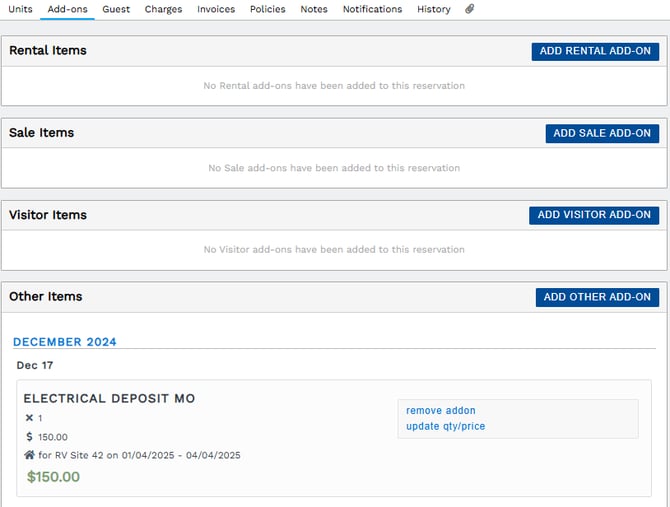 View and manage a reservation's add-ons on the Add-ons tab
An add-on's detail box displays available edit actions as well as a summary of the add-on, while the actual charges for the add-on are on the reservation's Charges tab.
TIP: If you are looking to change a security deposit for future uses, check out these resources...
-
To edit a security deposit add-on for all future use at the property, see: Reservation Add-ons
- To remove a security deposit from future reservations as a required add-ons, see: Required Add-ons
Close Out a Security Deposit, with refund if applicable
Closing out a deposit at a guest's departure is much easier than you may think!
Check out these 4 quick steps...
-
Pay unpaid charges, like final electric use or clean-up fees. You have two options:
-
Transfer funds from the deposit's original payment. This splits the original payment to show all or a portion moved to pay the unpaid charge(s). The transferred funds keep the original payment date to help the guest identify the security deposit's use.
- Refund to reservation credit from the deposit's original payment, then pay unpaid charge(s) with the reservation credit. This documents the deposit's use with a visual log. The guest can easily see the reservation credit refund on the security deposit as well as the reservation credit payments on the unpaid charge(s).
-
-
Pay unpaid POS transactions charged to the reservation by refunding to reservation credit then paying the POS transaction with reservation credit.
-
Refund the any funds remaining on the security deposit once you have ensured there are no outstanding balances.
-
Finally, zero out the deposit charge so there is no balance due. It is necessary to zero out the charge as the stay has ended and the guest no longer owes the deposit.
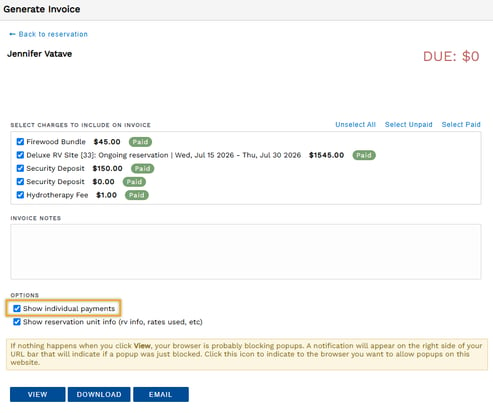
- If a guest asks for a receipt for the security deposit's use, you may send an invoice to share this financial activity. Go to the reservation's Invoices tab. When creating the invoice, be sure to check the option to "Show all payments." This will share all payment and refund activity for every charge you select.
IMPORTANT: Be sure to record the guest's final utility reading and post all applicable charges before closing out the deposit. If you forget to post final charges first and issue a refund for the security deposit, you may have to take a new payment and charge the guest's default payment method to cover the new charges.